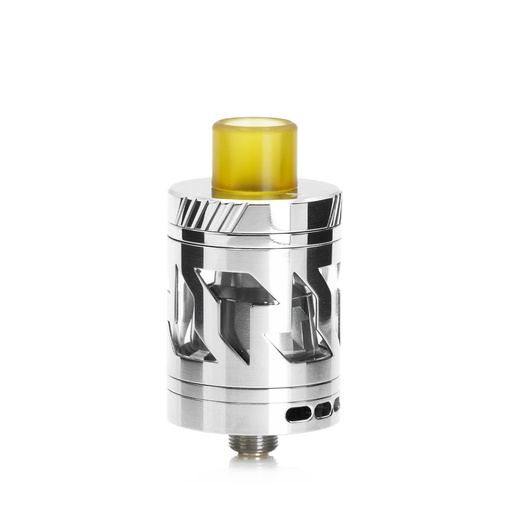
A mechanical mod is a simple object, but it does not make safety simple. It connects a battery directly to the atomizer's coil. There is no screen, no power adjustment and no electronics to cut off in case of error. This simplicity is appreciated for its feel and its repairability. In exchange, it requires you to understand what you are assembling.
In the workshop, we always reason in the same order: battery condition, actual coil resistance, contact quality, then testing. If any of these points is uncertain, the mod stays on the bench.
How does a mechanical mod produce vapor?
The tube holds a battery. The switch closes the circuit when you press it. Current then flows through the atomizer's coil, which heats the liquid held in the cotton. Release the switch and the circuit opens.
Power is not chosen on a screen. It depends on the battery voltage and the coil resistance. A charged battery delivers about 4.2 volts at the start, then its voltage drops during use. The vape therefore changes gradually as the battery discharges.
The LETO 2.1 illustrates this direct construction. Its lock ring prevents the switch from being pressed during transport. This lock does not replace checking the battery or having a good coil.
Who is this type of gear for?
The mechanical mod is for someone already comfortable with their atomizer, their builds and their batteries. You must know how to measure a coil's resistance with a reliable device, spot damaged insulation and choose a battery based on its continuous discharge current.
If you want to set a power level, read the charge on a screen or benefit from electronic protections, a regulated box mod is better suited. If you are new to vaping, start with simple electronic gear. You can come back to mechanical once the checks described here have become reflexes.
A mechanical mod is not a shortcut to stronger vaping. It is another way of building the circuit, with more responsibility left to the user.
How do you apply Ohm's law without jargon?
The useful relationship fits in one formula: current = voltage ÷ resistance. Current is expressed in amps, voltage in volts and resistance in ohms.
With a battery charged to 4.2 V and a coil measured at 0.30 Ω, the theoretical current is 14 A:
| Voltage | Resistance | Calculation | Theoretical current |
|---|---|---|---|
| 4.2 V | 0.30 Ω | 4.2 ÷ 0.30 | 14 A |
| 4.2 V | 0.20 Ω | 4.2 ÷ 0.20 | 21 A |
| 4.2 V | 0.15 Ω | 4.2 ÷ 0.15 | 28 A |
This value must stay below the continuous discharge current stated by the battery manufacturer. Do not use the "pulse" value as a reference. Keep a margin: contacts, temperature and battery age are not laboratory conditions.
The resistance must be measured after the build, then checked again after tightening and handling the atomizer. A value that moves indicates an unstable contact. It must be fixed before use.
How do you choose and inspect the battery?
Use the format the mod is designed for and a chemistry suited to this use. On the LETO 2.1 product page, the catalog lists an 18650 IMR battery with a continuous discharge current of at least 20 A. For another mod, follow its own manual and the battery manufacturer's specifications.
Before each assembly, look at the insulating wrap. A tear, even a small one, near the positive terminal can put the battery's metal in contact with the tube. Also check the top insulating ring. A battery marked by an impact, deformed or of unknown origin must not be used.
Always carry batteries outside the mod in an individual case. A key or a coin can bridge their terminals in a pocket and cause a short circuit. Never leave a loose battery in a bag.
How do you avoid a short circuit?
Start by working on a clean atomizer. The positive pin must protrude enough when the mod's connection requires it. No strand of wire should touch the cap or the deck. The screws must hold the coil without cutting it.
Measure the build on an ohm meter or an electronic box mod before placing it on the mechanical mod. Check that there is no short circuit, then break in the coil on regulated gear if the build allows it. The Leto RTA 20.24 atomizer is designed for a single-coil build, but "single" does not excuse you from measuring.
During use, stop immediately if the tube heats up, if the switch becomes abnormally hot, if crackling continues after you release it or if the smell changes. Put the gear down on a non-flammable surface, move away and do not disassemble a burning battery with bare hands.
What checks should you run before every outing?
- Measure the resistance and check that it stays stable.
- Examine the battery's wrap and insulator.
- Clean the dry contacts and make sure they move freely.
- Check the atomizer build and that there is no liquid in the connection.
- Test the switch lock.
- Put spare batteries in a dedicated case.
The mods-only category lets you compare models, but the right choice is the one whose battery format and matching build you master. The product manual always takes priority over any habit picked up with another tube.
Frequently asked questions
Is a mechanical mod suitable for beginners?
No. Start with regulated gear that handles common situations, then learn to measure your builds before considering a mechanical.
Can I use the resistance value shown by any box mod?
Use a reliable device and check that the measurement is stable. A value that varies after tightening or handling signals a build that needs to be redone.
Why is the switch lock not enough?
It mainly prevents an accidental press. It detects neither a damaged battery, nor a coil that is too low, nor a short circuit in the atomizer.